Statistical studies in immunity : smallpox and vaccination / by John Brownlee.
- Brownlee, John, 1868-1927.
- Date:
- 1905
Licence: In copyright
Credit: Statistical studies in immunity : smallpox and vaccination / by John Brownlee. Source: Wellcome Collection.
Provider: This material has been provided by The University of Glasgow Library. The original may be consulted at The University of Glasgow Library.
19/20 (page 331)
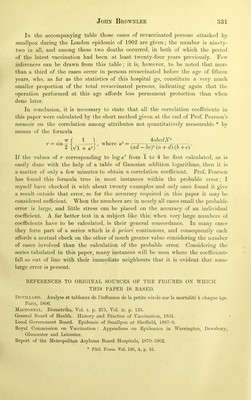
![In the accompanying table those cases of revaccinated persons attacked by smallpox during the London epidemic of 1902 are given; the number is ninety- two in all, and among these two deaths occurred, in both of which the period of the latest vaccination had been at least twenty-four years previously. Few inferences can be drawn from this table; it is, however, to be noted that more than a third of the cases occur in persons revaccinated before the age of fifteen years, who, as far as the statistics of this hospital go, constitute a very much smaller proportion of the total revaccinated persons, indicating again that the operation performed at this age affords less permanent protection than when done later. In conclusion, it is necessary to state that all the correlation coefficients in this paper were calculated by the short method given at the end of Prof Pearson’s memoir on the correlation among attributes not quantitatively measurable * by means of the formula r where Method {ad — hef {a + d) {b + c)' If the values of r corresponding to log/c“ from 1 to 4 be first calculated, as is easily done with the help of a table of Gaussian addition logarithms, then it is a matter of only a few minutes to obtain a correlation coefficient. Prof. Pearson has found this formula true in most instances within the probable error; I myself have checked it with about twenty examples and only once found it give a result outside that error, so for the accuracy required in this pa]3er it may be considered sufficient. When the numbers are in nearly all cases small the probable eiTor is large, and little stress can be placed on the accuracy of an individual coefficient. A far better test in a subject like this, when very large numbers of coefficients have to be calculated, is their general concordance. In many cases they form part of a series which is d priori continuous, and consequently each affords a mutual check on the other of much greater value considering the number of cases involved than the calculation of the probable error. Considering the series tabulated in this paper, many instances will be seen where the coefficient.^ fall so out of line with their immediate neighbours that it is evident that some large error is present. REFERENCES TO ORIGINAL SOURCES OF THE FIGURES ON WHICH THIS PAPER IS BASED. Duvillard. Analyse et tableaux de I’influence de la petite verole sur la mortalite fi chaque age. Paris, 1806. Macdonell. Biometrika, Vol. i. p. 375, Vol. ii. p. 135. General Board of Health. History and Practice of Vaccination, 1851. Local Government Board. Epidemic of Smallpo.x at Sheffield, 1887-8. Royal Commission on Vaccination: Appendices on Epidemic.s in Warrington, Dewsbury, Gloucester and Leicester. Report of the Metropolitan Asylums Board Hospitals, 1870-1902. * Phil. Trans. Vol. 195, A, p. 16.](https://iiif.wellcomecollection.org/image/b24931147_0021.jp2/full/800%2C/0/default.jpg)