A treatise on the venereal disease / by John Hunter ; with notes by George G. Babington.
- John Hunter
- Date:
- 1841
Licence: Public Domain Mark
Credit: A treatise on the venereal disease / by John Hunter ; with notes by George G. Babington. Source: Wellcome Collection.
Provider: This material has been provided by the National Library of Medicine (U.S.), through the Medical Heritage Library. The original may be consulted at the National Library of Medicine (U.S.)
22/348
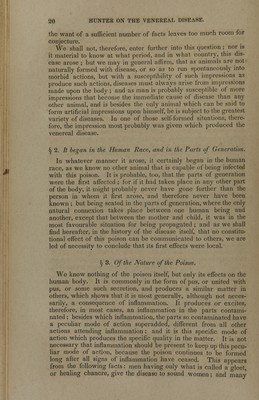
![The matter which is impregnated with this poison, when it comes in contact with a living part, irritates that part, and inflammation is the common consequence. It must be applied either in a fluid state, or rendered fluid by the juices of the partjo which it is ap- plied. There is no instance where it has given the infection in the form of vapour, as is the case in many other poisons. move it in the first instance, by very careful ablution, the individual may have connexion with a sound woman without danger of infecting her. The second conclusion cannot be too strongly reprobated. It is opposed to every day's experience ; and from the omission of the passage in Sir E. Homes edition, it may be supposed that further observation had led the author himself to change his opinion before the termination of his life. The former position also is by no means free from danger, as will be seen by the following instances, which are far from singular: A married Avoman was seized with the usual symptoms of gonorrhoea, which greatly surprised her. as her husband was free from complaint. On questioning, however, the husband, he confessed that he had had connexion with a common girl about a week before his wife complained ; but he positively asserted that he had had no discharge or uneasiness whatever, and certainly then showed no signs of disease. In about four days afterwards, that is to say, nearly a fortnight after the impure connexion, and a week after he must have communicated the disease to his wife, a gonorrhceal discharge appeared on him. A gentleman, when absent from home, exposed himself to the hazard of infec- tion. At the end of three days he returned home, and in about four days after- wards his wife had a gonorrhoea. On the tenth day after the connexion the gen- tleman first perceived a discharge, and the other symptoms of gonorrhoea. But it may be said, that though such cases show that the conclusion at which the author has arrived is practically unsafe, they by no means disprove the truth of the general principle on which it was founded. It may be said, that in these cases it is an error to suppose that there is no purulent secretion ; that in the very early stage of a gonorrhoea it is probable that the pus is too small in quantity to flow from the urethra; that it lodges in the lacuna?, and is washed out by the urine, and is thus concealed from observation, but that it not less really exists; and that the position therefore remains untouched,—that where there is no matter there can be no infection. However, there is another class of cases which go still further to throw doubts on the truth of this doctrine. A gentleman was exposed to infection when in London. A day or two after- wards he set off for Ireland, where his family resided. He made some stay at Cheltenham, and while there, there appeared on the inner prepuce two or three small indurations or tubercles. He showed them to a surgeon, who convinced himself that there was no ulceration, and did not believe the affection to be vene- real. After a short interval he returned to Ireland, these indurations still exist- ing, and infected his wife, who suffered from primary sores. A gentleman had an induration on the penis, which remained after the healing of a chancre. He suffered repeatedly from secondary symptoms, which were as often removed by appropriate treatment, but the induration always remained. At length, when a considerable interval had passed without a relapse, and he believed himself to be finally cured, he married, though the induration was not removed. His wife was infected. Cases of this kind might be multiplied without difficulty, and almost neces- sarily lead to the inference that infection may take place from the contact of a simple chancrous thickening, although no ulceration whatever is present. A misconception of this truth has often led to consequences which are most la- rtentable. In a considerable proportion of those cases in which a wife has been infected in consequence of marriage with a man labouring under syphilis, the communication seems to have taken place from the cicatrix of a sore which has been healed.]](https://iiif.wellcomecollection.org/image/b21131508_0022.jp2/full/800%2C/0/default.jpg)