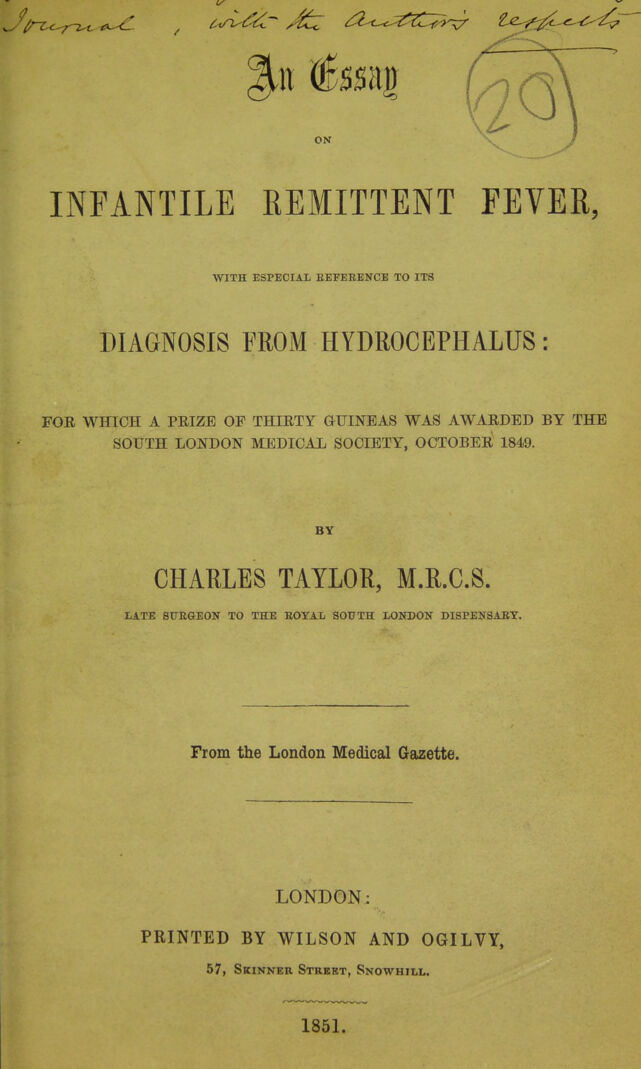
An essay on infantile remittent fever, with especial reference to its diagnosis from hydrocephalus : for which a prize of thirty guineas was awarded by the South London Medical Society, October 1849 / by Charles Taylor, M.R.C.S.
- Taylor, Charles, M.R.C.S.
- Date:
- 1851
Licence: Public Domain Mark
Credit: An essay on infantile remittent fever, with especial reference to its diagnosis from hydrocephalus : for which a prize of thirty guineas was awarded by the South London Medical Society, October 1849 / by Charles Taylor, M.R.C.S. Source: Wellcome Collection.
Provider: This material has been provided by The University of Glasgow Library. The original may be consulted at The University of Glasgow Library.
8/44 page 6
![tlreii, similar to this slight fever at their coinmeucement.* In addition to the foregoing opinions, we find that several cases of remittent fever are related as arising from the pre- sence of a foreign body in the intestinal canal. Evanson relates a case pro- duced from a child swallowing a mai'- ble; Mackintosh another case, from a mass of undigested food ; and Dr. Cot- ton reports a casef where a severe at- tack of ]-emittent fever occurred, which immediately subsided on the expulsion of a foreign body. These cases would accoi-d with the opinion of those who consider the disease to consist in irrita- tion and inflammation of the digestive tube; as, doubtless, the presence of a foreign body would set up such irrita- tion. The experience of Dr. Tweedie, how- ever, seems to be at variance with those who consider the two diseases (infantile remittent fever and continued fever in the adult) identical; for of 676 cases of fever in the Fever Hospital, only eigh- teen were under ten years of age ; and he says, as a general rule, children, and particularly infants, are exempt Irorn the causes of idiopathic fever, the febrile ailments to wliicli they are sub- ject being almost always symptomatic of some local disturbance, as dentition aud disorder of the bowels.j From the j^receding somewhat con- flicting opinions, it is evident that the several authors have each described a form of febrile disease, as it especially has come under their notice; for in- stance, one (Dr. Locock) has met with the disease chiefly among the children of the more affluent, who are less ex- posed to the influence of malaria, but, perliaps, more to indulgence in the quantity mul quality offood ; and lience describes it as mostly occurring at Christmas time, almost always depend- ing on over-feeding, and other direct ex citing causes of irritation of the mucous membrane, and«ever proceeding from the state of the atmosphere, and never contagious; while Butter, who first described it, aud the results of his expe rience from an epidemic in Derbyshire, says tlie acute form is epidemic and also contagious. West and Willshiro describe it as seen at the Infirmary for * Rep on Dis. of London, p. 75. t Med. Gaz., .lune 1848. % Art. Fever, Cyc. Pract. Med. Cliildren, in the neighbourhood of which epidemic and endemic causes are rife, and di-aw a conclusion that it is identical with continued fever. Hence, and from our own experience, we conclude that fevers, as they occur in children, hitherto classed under tlie one he9,d of Infantile Remittent Fe- ver, arise ft-om a diversity of causes, and include several forms of disease; that in all febrile afiections in children there is universally a tendency to assume the periodic form; that the remission or periodicity is greater, or more marked, in proportion to their youth; that the remission is more distinct when the dis- ease can be fairly traced to malaria; but that, when it has arisen fi-om direct irritating causes applied to the gastro- intestinal mucous membrane, the remis- sions are more irregular, and occur in a slight degree several times a day; that in all forms of fever in children, but more especially at certain times, and in certain localities, there is a tendency to gastro-intestinal initation and inflam- mation ; that this irritation is secon- dary to the fever when of miasmatic origin, and not, as Broussais taught, as actually giving rise to or constituting tlie disease itself, but rather as a coin- Ijlication ; that when it has aiisen from direct in-itating causes, it is primary, and the disease is to be considered as idiopathic irritation or inflammation of the intestinal mucous membrane, and not as an idiopathic fever; and, lastly, that tme malarial fever is often compli- cated with, or follows after, gasti-o-intes- tinal irritation arising from other causes. Causes.—Certain hygrometric and thermouietric conditions of the atmo- sphere, as damp and cold, warm aud moist weather, and the occuirence of easterly winds, perhaps ])redispose to an attack of fever;* insutiiciency of, or bad food; exposure to the weather; change of re- sidence from a country to a town dis- trict; residence in badly ventilated or damp localities, or in situations where malaria is constant; the occurrence of contiuuedfevor as an epidemic,- may all be considered cither as predisposing or exciting causes of fever in children. * It would be n useful snl)ject of inquiry, from the weekly meteorolosicnl observations, to deter- mine the connexion of fever with the state of the weather, in ret'eience to tlie deirree of heat, mois- ture, electricity, and tlie prevalence of certain winds: this would, however, have required more time and observation than could be given in the present essay.](https://iiif.wellcomecollection.org/image/b21475477_0008.jp2/full/800%2C/0/default.jpg)