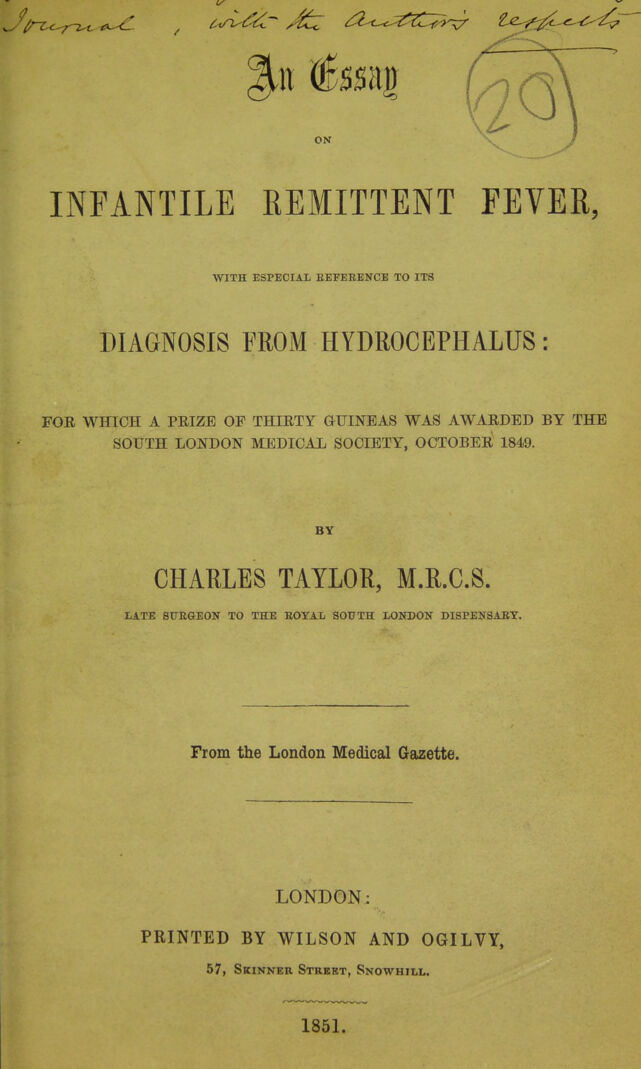
An essay on infantile remittent fever, with especial reference to its diagnosis from hydrocephalus : for which a prize of thirty guineas was awarded by the South London Medical Society, October 1849 / by Charles Taylor, M.R.C.S.
- Taylor, Charles, M.R.C.S.
- Date:
- 1851
Licence: Public Domain Mark
Credit: An essay on infantile remittent fever, with especial reference to its diagnosis from hydrocephalus : for which a prize of thirty guineas was awarded by the South London Medical Society, October 1849 / by Charles Taylor, M.R.C.S. Source: Wellcome Collection.
Provider: This material has been provided by The University of Glasgow Library. The original may be consulted at The University of Glasgow Library.
7/44 page 5
![firmation of the doctrines of Broussais, as to the natin-e of feA-er, in the acknow- ledged cause of this disease . . the most prominent symptoms being re- ferred to the mucous lining of the stomach and intestines; and a ]n-otracted or acute fonn of fever is the result.* Maunsell and Evanson say— In classing the infantile remittent fever among disorders of the digestive organs, we declare sufficiently our opinion of its origin and nature. . . . Its cha- racteristic symptoms, if closely analysed, will be found, all of them, to point to the mucous surface as the original seat of morbid action. Sir H. Marsh says, the seat is in the villous coat of the intestines. Mackintosh is of opinion that it de- pends on irritation, inflammation, or ulceration of the mucous membrane of the stomach and bowels. Dr. Coley seems to be of the opinion that it may be a symptomatic fever, as he says it is one of the most frequent teriiiiuations of chronic dysenteiy. It is frequently the sequel of measles, scarlatina, and other diseases where there has been inflammation of the in- testinal mucous membrane. But he considers the most unfavourable form is from malai'ia and the efiiuvia of pci- sons laboiiring under tyjihus fever. Dr. Golding Bird considers there are two distinct diseases described under this name, one depending almost en- tirely on derangement oi the functions of the gastro-intestinal tube, the other on more or less of malarious influence, this latter constituting the true in- fantile remittent fever; but that the two frequently coexist. Rilliett and Barthez, who have inves- tigated the disease as it occim-ed in the Hopital des Enfans, in Paris, and whose observations are founded on 111 cases, regard remittent lever as identi- cal with typhoid fever in the adult, and as intimately connected with inflamma- tion of the intestines. Drs. Copland and Willshire affiim that the digestive disorder itseli pro- * Since this essay was written, Dr. Churchill's work on the Diseases of Children has appearecl. He terms the disease infantile remittent fever, worm fever, pastric fever (p. 637), thereby showing his oj inion ; and at p. 048 he is inclined to the opinion that it is a jmstro-en- teritc, although heafter«ard.s, in the niilder cases, thinks the gastric t-ymptonis as a conipli- cation, rather than as being essential to the disease. ceeds from an anterior disorder, which it- self proceeds from causes impairing the energy of the nervous, system, and of the organs by which this system is more immediately influenced. The latter says, the same deleterious influences which cause continued fever in the adult will cause remittent fever in chil- dren ; while the former, after allow- ing that improper food and neglect of the bowels have their full share in pro- ducing it, says it arises most fre- quently from the same causes as pro duce other periodic fevers, namely, ter- restrial exhalations or miasmata; and that less intense or concentrated states of these exhalations than are required to produce either agues or remittents in adults will often cause the latter in childi-en. Dr. C. West, our most recent author on the subject, follows the opinion of Rilliet and Barthez, and considers it identical with continued fever in the adult. If, says he, we look closely to the characters of this disease, and compare them with those of simple con- tinued fever in the adult, there is so close a correspondence as to remove all causes of doubt as to theii- identity. And he draws a comparison between them in the circumstances of their oc- currence, their local complications, and their 23ost mortem appearances. Dr. Bateirian, in his Reports of the Diseases of London, acknowledges and points out the connection of infan tile remittent fever with continued and typhoid fever, and also the difier- ent forms or types under which it some- times appears; for we find in one place his cases are registered undei- one name, in another place under another name ; for instance, they are registered more generally as Febris infantmn; but in 1803, winter quarter, and in 1811, sum- mer quarter, it is Febris infantilis remittens; in 1811, autumn quarter, the cases are termed Continued fe- ver of a remittent character. It is evident they all refer to the same class of cases. He also alludes to a slight fever, oF short dimition, among young people, removed in three or four^days; but in a few it continued for three or four weeks, and in one or two instances, without i)utting on a typhoid appear- ance, it spread to two. three, or more members of the same family. Four cases are described by him as typhus, and occurring in young chil-](https://iiif.wellcomecollection.org/image/b21475477_0007.jp2/full/800%2C/0/default.jpg)