The vegetable kingdom, or, The structure, classification, and uses of plants : illustrated upon the natural system / by John Lindley ; with upwards of five hundred illustrations.
- John Lindley
- Date:
- MDCCCXLVIII [1847]
Licence: Public Domain Mark
Credit: The vegetable kingdom, or, The structure, classification, and uses of plants : illustrated upon the natural system / by John Lindley ; with upwards of five hundred illustrations. Source: Wellcome Collection.
Provider: This material has been provided by King’s College London. The original may be consulted at King’s College London.
60/990
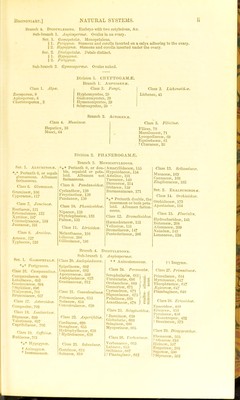
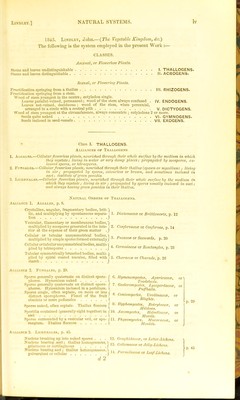
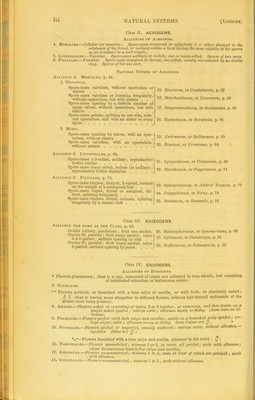
![Class II. ACROGENS. Alliances of Acrogens. 4. Muscales.—Cellular (or vascular). Spore-cases immersed or calyptrate (i. e. either plunged in the substance of the frond, or inclosed within a hood having the same relation to the spores as an involucre to a seed-vessel). 5. Lycopodales.— Vascular. Spore-cases axillary or radicle, one or many-ceUed. Spores of two sorts. 6. Filicales.— Vascular. Spore-cases marginal or dorsal, one-celled, usually surrounded by an elastic ring. Spores of but one sort. Natural Orders of Acrogens. Alliance 4. Muscales, p. 54. 1. Hepatic.®. Spore-cases valveless, without operculum or) elaters j Spore-cases valveless or bursting irregularly,! without operculum, but with elaters . . .] Spore-cases opening by a definite number of) equal valves, without operculum, but with > elaters I Spore-cases peltate, splitting on one side, with-1 out operculum, and with an elater to every > spore J 15. Ricciaccce, or Cryslalworts, p. 57 16. Marchantiacea, or Liverworts, p. 58 17. Jungermanniacece, or Scalemosses, p. 59 18. Equisetacece, or Horsetails, p. 61 2. Musci. Spore-cases opening by valves, with an oper-1 ~ ... culum, without elaters . ...... . j W. Andraaceas, or Splitmosses, p. 63 Spore-ca8e9 valveless, with an operculum.) OA „ ~ without elaters . . 1 j 20- Bri'>acc<e> or Urnmosses, p. 64 Alliance 5. Lycopodales, p. 68. SPb°ordles sfmiUr celled’. a!illftry.! T°ducUve} M. Lycopodiaceec, or Clubmosses, p. 69 Spore cases many-celled, radicle (or axillary) ;1 Mani,m,fa, pP1me.rum-ls n 71 reproductive bodies dissimilar j Marsueaccte, 01 vcpperwoi is, p. 7t Alliance 6. Filicales, p. 74. Spore-cases ringless, distinct, 2-valved, formed! on the margin of a contracted leaf . . . .j Spore-cases ringed, dorsal or marginal, dis- > tinct, splitting irregularly j Spore-cases ringless, dorsal, connate, splitting! irregularly by a ventral cleft j 23. Ophiogtossaccce, or Adders' Tongues, p. 77 24. Polypodiaccee, or Ferns, p. 78 25. Danteacew, or Danieads, p. 82 Class III. RHIZOGENS. Alliance the same as the Class, p. 83. Ovules solitary, pendulous ; fruit one-seeded. Ovules 00, parietal; fruit many-seeded ; calyx! 3-4-6-parted ; anthers opening by slits . .j Ovules 00, parietal; fruit many-seeded, calyx 1 5-parted, anthers opening by pores. . . .j 26. Balanophoracres, or Cynomoriums, p. 27. Cytinacew, or Cistusrapes, p. 91 28. liaflcsiacece, or Palmaworts, p. 93 89 Class IV. ENOOGENS. Alliances of Endogens. * Flowers glumaceous ; (that is to say, composed of bracts not collected in true whorls, but consisting of imbricated colourless or herbaceous scales). 7. Glum ales. ** Flowers petaloid, or furnished with a true calyx or corolla, or with both, or absolutely naked; S ? (that is having sexes altogether in different flowers, without half-formed rudiments of the absent sexes being present). 8. Arales.—Flowers naked or consisting of scales, 2 or 3 together, or numerous, and then sessile on a simple naked spadix ; embryo axlle; albumen mealy or fleshy. (Some have no al- bumen). 9. Palmai.es.—Flowers perfect (with both calyx and corolla), sessile on a branched scaly spadix ; em- bryo vague, solid ; albumen horny or fleshy. Some Palms are Q . • 10. Hydrales.—Flowers perfect or imperfect, usually scattered; embryo axile, without albumen.— aquatics. (Some are 0.) *»*—Flowers furnished with a true calyx and corolla, adherent to the ovary ; 0. 11. Narcissales.—Flowers symmetrical; stamens 3 or 6, or more, all perfect; seeds with albumen; (Some Bromcliaccce have a free calyx and corolla). 12. Amomai.es.—Flowers unsymmetrical; stamens 1 to 5, some at least of which arc petaloid ; seeds with albumen. 13. Orchidales.—Flowers unsymmclrical; stamens 1 to 3 j seeds without albumen.](https://iiif.wellcomecollection.org/image/b2130774x_0060.jp2/full/800%2C/0/default.jpg)
 No text description is available for this image
 No text description is available for this image
 No text description is available for this image