A manual of hygiene and sanitation / By Seneca Egbert.
- Egbert, Seneca, 1863-1939
- Date:
- [1907], [©1907]
Licence: Public Domain Mark
Credit: A manual of hygiene and sanitation / By Seneca Egbert. Source: Wellcome Collection.
Provider: This material has been provided by the Augustus C. Long Health Sciences Library at Columbia University and Columbia University Libraries/Information Services, through the Medical Heritage Library. The original may be consulted at the the Augustus C. Long Health Sciences Library at Columbia University and Columbia University.
18/500 page 22
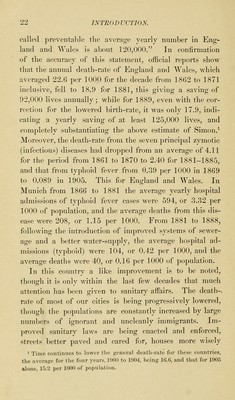
![called ])revental)le the average yearly number in Eng- land and Wale- i.< abniit 120,000. In confirmation of the accuracy of this statement, official reports show that the annual death-rate of Englaud and Wales, which averaged 22.6 per 1000 for the decade from 1862 to 1871 inclusive, fell to 18.9 for 1881, this giving a saving of 02,000 lives annually; while for 1889, even with the cor- rection for the lowered birth-rate, it was only 17.9, indi- cating a yearly saving of at least 125,000 lives, and completely substantiating the above estimate of Simon.^ Moreover, the death-rate from the seven principal zymotic (infectious) diseases had dropped from an average of 4.11 for the period from 1861 to 1870 to 2.40 for 1881-1885, and that from typhoid fever from 0.39 i)er 1000 in 1869 to 0.089 in 1905. This for England and Wales. In Munich from 1866 to 1881 the average yearly hospital admissions of typhoid fever cases were 594, or 3.32 per 1000 of population, and the average deaths from this dis- ease were 208, or 1.15 per 1000. From 1881 to 1888, following the introduction of improved systems of sewer- age and a better water-supply, the average hospital ad- missions (typh(.id) were 104, or 0.42 per 1000, and the average deaths were 40, or 0.16 per 1000 of population. In this country a like improvement is to be noted, though it is onlv within the last few decades tliat much attention has been given to sanitary affairs. The death-, rate of most of our cities is l^eing progressively lowered, though the populations are constantly increased by large numbers of ignorant and uncleanly immigrants. Im- ])roved sanitary laws are being enacted and enforced, streets Ijetter paved and cared for, houses more wisely ' Time continues to lower tlie general death-rate for these countries, the average for the four years. 1900 to 1904, being 16.6, and that for 1905 alone, 1.5.2 per 1000 of population.](https://iiif.wellcomecollection.org/image/b2122349x_0018.jp2/full/800%2C/0/default.jpg)