Skip to main content
Wellcome Collection homepage
Visit us
What’s on
Stories
Collections
Get involved
About us
Sign in to your library account
Search for anything
Library account
Search for anything
Search
Images search
Search for images
Search
All
All
Catalogue
Catalogue
Images
Images
Events and exhibitions
Events and exhibitions
Stories
Stories
Colours
Licences
Public Domain Mark (23)
Creative Commons CC-BY (13)
In copyright (11)
Creative Commons CC-BY-NC (9)
Dates
From
to
Types/Techniques
Lithographs (13)
Posters (10)
Photographs (5)
Ephemera (4)
Photographic postcards (4)
Photographic prints (4)
Albumen prints (3)
Engravings (3)
Mezzotints (3)
Portrait photographs (3)
Portrait prints (3)
Advertising cards (2)
Gouaches (2)
Paintings (2)
Wood engravings (2)
Blotting paper (1)
Broadsides (1)
Etchings (1)
Intaglio prints (1)
Paper toys (1)
Subjects
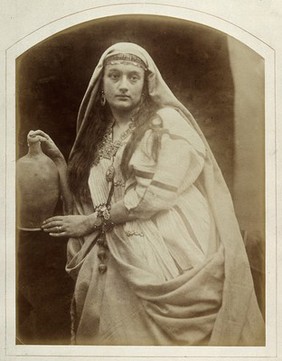
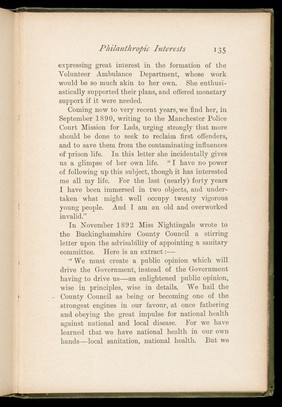
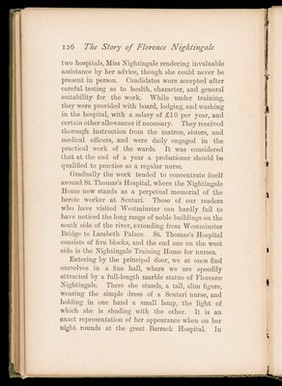
Nightingale, Florence, 1820-1910 (29)
Drugs (20)
Addiction (14)
Poppy (14)
Women heroes (12)
Confectionary (11)
Medicinal Plant (11)
Heroines in literature (10)
AIDS (Disease) (9)
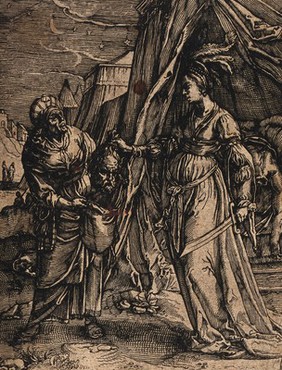
Beheading (7)
Deception (7)
Holofernes (Biblical figure) (7)
Judith (Biblical figure) (7)
Women in Judaism (7)
Head (6)
Heroin (6)
AIDS (Disease) - Prevention (5)
Safe sex in AIDS prevention (5)
Seduction (5)
Sex in the Bible (5)
Contributors
Wintle, W. J (24)
Sue Snell (10)
Campbell, Edward R., 1787-1857 (5)
Gardiner, James (4)
Cameron, Julia Margaret, 1815-1879 (3)
Dr Henry Oakeley (3)
Deutsche AIDS-Hilfe e.V (2)
Dr. J.C. Ayer & Co (2)
Hoppner, Lascelles H., 1788- (2)
Meyer, Henry Hoppner, 1783-1847 (2)
Padovanino, 1588-1648 (2)
Allori, Cristofano, 1577-1621 (1)
Bundeszentrale für Gesundheitliche Aufklärung (Germany) (1)
Evans, Edmund, 1826-1905 (1)
George IV, King of Great Britain, 1762-1830 (1)
Goltzius, Hendrik, 1558-1617 (1)
H., W., active 1883 (1)
Hanfstaengl, Franz, 1804-1877 (1)
Iblher, Peder, 1965- (1)
Martin H. Smith Company (1)
Submit
82 results
Search result sorting
Sort by:
Relevance
Production dates
Sort order:
Ascending
Descending
Submit
Previous (page 1)
Page
2
of 3
Next (page 3)
Close modal window
Previous (page 1)
Page
2
of 3
Next (page 3)



![Papaver somniferum L. Papaveraceae Opium Poppy Distribution: Asia minor, but has been dated to 5000BC in Spanish caves. Now grows almost everywhere. The oldest medicine in continuous use, described in the Ebers' papyrus (1550 BC), called Meconium, Laudanum, Paregoric and syrup of poppies. Culpeper (1650) on Meconium '...the juyce of English Poppies boyled till it be thick' and 'I am of the opinion that Opium is nothing else but the juyce of poppies growing in hotter countries, for such Opium as Authors talk of comes from Utopia.[he means an imaginary land, I suspect]’]. He cautions 'Syrups of Poppies provoke sleep, but in that I desire they may be used with a great deal of caution and wariness...' and warns in particular about giving syrup of poppies to children to get them to sleep. The alkaloids in the sap include: Morphine 12% - affects ?-opioid receptors in the brain and causes happiness, sleepiness, pain relief, suppresses cough and causes constipation. Codeine 3% – mild opiate actions – converted to morphine in the body. Papaverine, relaxes smooth muscle spasm in arteries of heart and brain, and also for intestinal spasm, migraine and erectile dysfunction. Not analgesic. Thebaine mildly analgesic, stimulatory, is made into oxycodone and oxymorphone which are analgesics, and naloxone for treatment of opiate overdose – ?-opioid receptor competitive antagonist – it displaces morphine from ?-opioid receptors, and constipation caused by opiates. Protopine – analgesic, antihistamine so relieves pain of inflammation. Noscapine – anti-tussive (anti-cough). In 2006 the world production of opium was 6,610 metric tons, in 1906 it was over 30,000 tons when 25% of Chinese males were regular users. The Opium wars of the end of the 19th century were caused by Britain selling huge quantities of Opium to China to restore the balance of payments deficit. Laudanum: 10mg of morphine (as opium) per ml. Paregoric: camphorated opium tincture. 0.4mg morphine per ml. Gee’s Linctus: up to 60 mg in a bottle. J Collis Browne’s chlorodyne: cannabis, morphine, alcohol etc. Kaolin and Morph. - up to 60 mg in a bottle. Dover’s Powders – contained Ipecacuana and morphine. Heroin is made from morphine, but converted back into morphine in the body (Oakeley, 2012). One gram of poppy seeds contains 0.250mgm of morphine, and while one poppy seed bagel will make a urine test positive for morphine for a week, one would need 30-40 bagels to have any discernible effect. Photographed in the Medicinal Garden of the Royal College of Physicians, London.](https://iiif.wellcomecollection.org/image/B0009101/full/282%2C/0/default.jpg)
![Papaver somniferum L. Papaveraceae Opium Poppy Distribution: Asia minor, but has been dated to 5000BC in Spanish caves. Now grows almost everywhere. The oldest medicine in continuous use, described in the Ebers' papyrus (1550 BC), called Meconium, Laudanum, Paregoric and syrup of poppies. Culpeper (1650) on Meconium '...the juyce of English Poppies boyled till it be thick' and 'I am of the opinion that Opium is nothing else but the juyce of poppies growing in hotter countries, for such Opium as Authors talk of comes from Utopia [he means an imaginary land, I suspect]’. He cautions 'Syrups of Poppies provoke sleep, but in that I desire they may be used with a great deal of caution and wariness...' and warns in particular about giving syrup of poppies to children to get them to sleep. The alkaloids in the sap include: Morphine 12% - affects ?-opioid receptors in the brain and causes happiness, sleepiness, pain relief, suppresses cough and causes constipation. Codeine 3% – mild opiate actions – converted to morphine in the body. Papaverine, relaxes smooth muscle spasm in arteries of heart and brain, and also for intestinal spasm, migraine and erectile dysfunction. Not analgesic. Thebaine mildly analgesic, stimulatory, is made into oxycodone and oxymorphone which are analgesics, and naloxone for treatment of opiate overdose – ?-opioid receptor competitive antagonist – it displaces morphine from ?-opioid receptors, and reverses the constipation caused by opiates. Protopine – analgesic, antihistamine so relieves pain of inflammation. Noscapine – anti-tussive (anti-cough). In 2006 the world production of opium was 6,610 metric tons, in 1906 it was over 30,000 tons when 25% of Chinese males were regular users. The Opium wars of the end of the 19th century were caused by Britain selling huge quantities of Opium to China to restore the balance of payments deficit. Laudanum: 10mg of morphine (as opium) per ml. Paregoric: camphorated opium tincture. 0.4mg morphine per ml. Gee’s Linctus: up to 60 mg in a bottle. J Collis Browne’s chlorodyne: cannabis, morphine, alcohol etc. Kaolin and Morph. - up to 60 mg in a bottle. Dover’s Powders – contained Ipecacuana and morphine. Heroin is made from morphine, but converted back into morphine in the body (Oakeley, 2012). One gram of poppy seeds contains 0.250mgm of morphine, and while one poppy seed bagel will make a urine test positive for morphine for a week, one would need 30-40 bagels to have any discernible effect. Photographed in the Medicinal Garden of the Royal College of Physicians, London.](https://iiif.wellcomecollection.org/image/B0009102/full/282%2C/0/default.jpg)
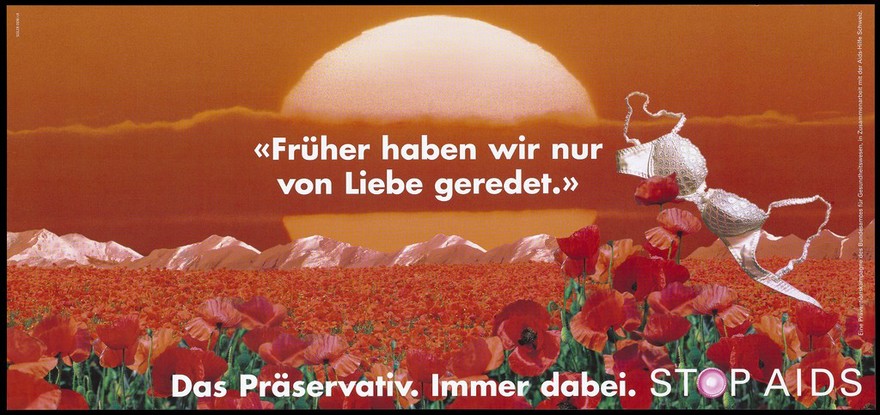


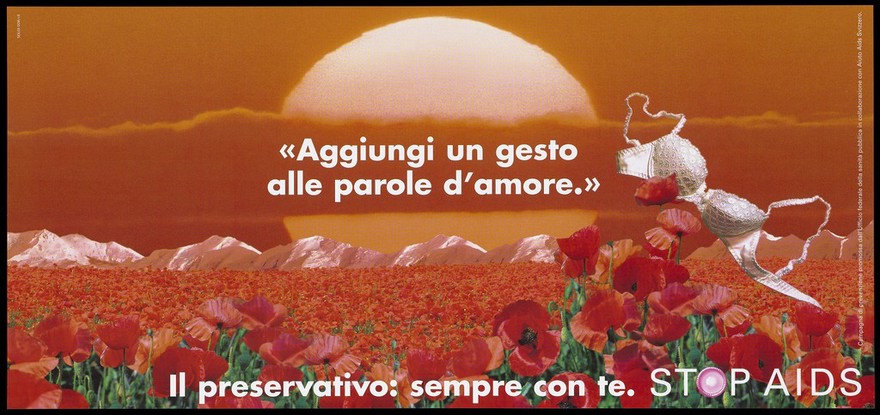


![A field of poppies and a white bra floating against a red sunset representing an advertisement for safe sex; French version of a series of 'Stop SIDA' [Stop AIDS] campaign posters by the Federal Office of Public Health , in collaboration with l'Aide Suisse contre le SIDA. Colour lithograph.](https://iiif.wellcomecollection.org/image/b16746211_l0053702.jp2/full/880%2C/0/default.jpg)